Talks, competition entries, and pitch materials from the O-Seal team.
TalkJune 5, 2026
Sealing leaks, protecting rights: youth-led AI for water access without excavation
Right Here, Right Now Global Youth Climate Summit
Co-hosted by University of Oxford Saïd Business School · Oxford Smith School of Enterprise and the Environment · UN Office of the High Commissioner for Human Rights (OHCHR) · Right Here, Right Now Global Climate Alliance
A 15-minute youth speaker session led by team captain Maneesh Vaddi, with contributions from Dhruv Miriyala and Zoeb Izzi. On AI-driven water infrastructure repair as a human rights mechanism: moving from concept to faculty validation, and why low-disruption, low-cost repairs could be especially valuable in settings where budgets are tight and reliable water access is a matter of rights.
CompetitionTop 100 / 4,800 teams
Blue Ocean Entrepreneurship Competition: Global Top 100 Entry
Blue Ocean Entrepreneurship Competition · 173 countries
O-Seal’s official submission video for the Blue Ocean Entrepreneurship Competition, placing in the global Top 100 out of 4,800 teams from 173 countries. One of only 7 Virginia teams to reach the global Top 100.
Harvard Crimson Business Competition: Global Championship Qualifying Entry
Harvard Crimson Business Competition · Global Championship Round at Harvard, Cambridge, MA · June 25–28, 2026
The full pitch deck submitted for the Harvard Crimson Business Competition, advancing O-Seal to the Global Championship Round at Harvard in Cambridge, MA. Top 80 of 600 submissions drawn from 40+ eligible countries. Covers the technology, unit economics, Leak-as-a-Service model, market sizing, and roadmap.
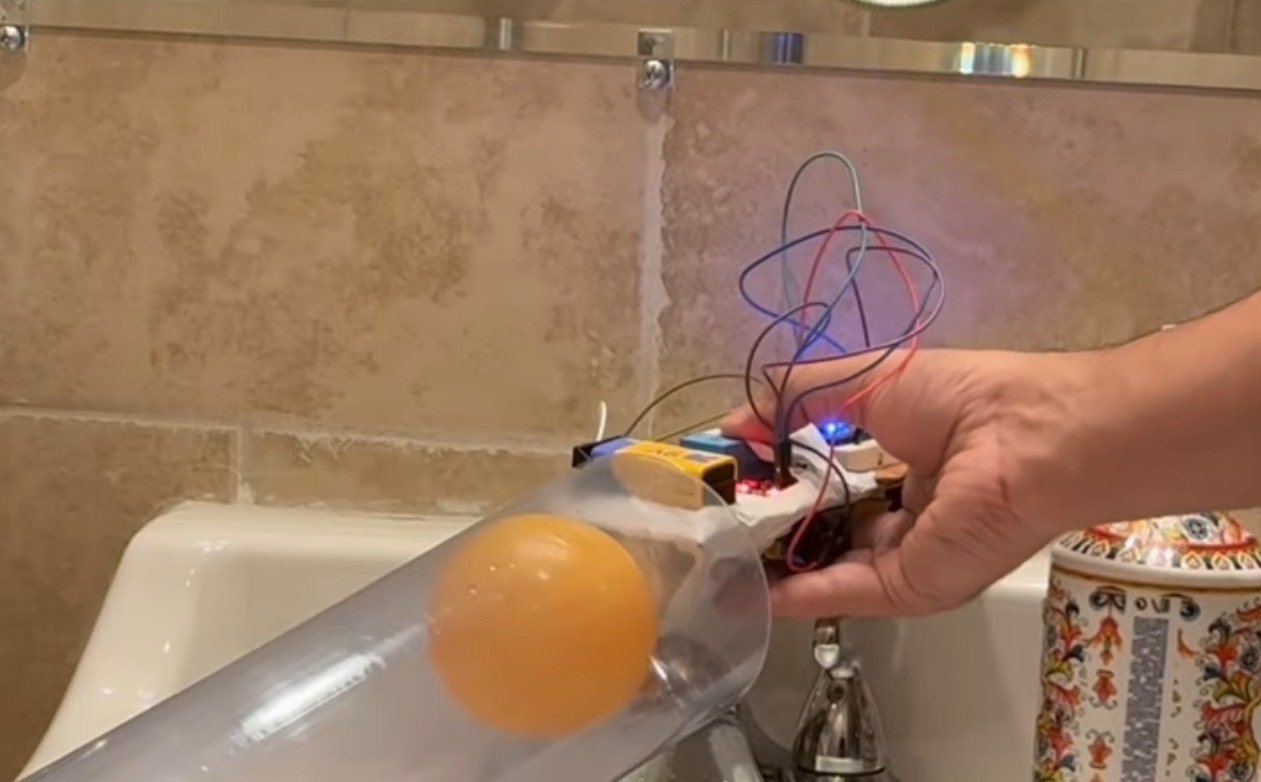
An early-stage functional prototype tested using a transparent PVC pipe section and a faucet as the water source. The balloon-based inflatable mechanism demonstrated the core sealing concept: a pressurized inflatable element anchors against the pipe wall to stop flow through a breach. This bench test informed the geometry and inflation approach that evolved into the torus design.
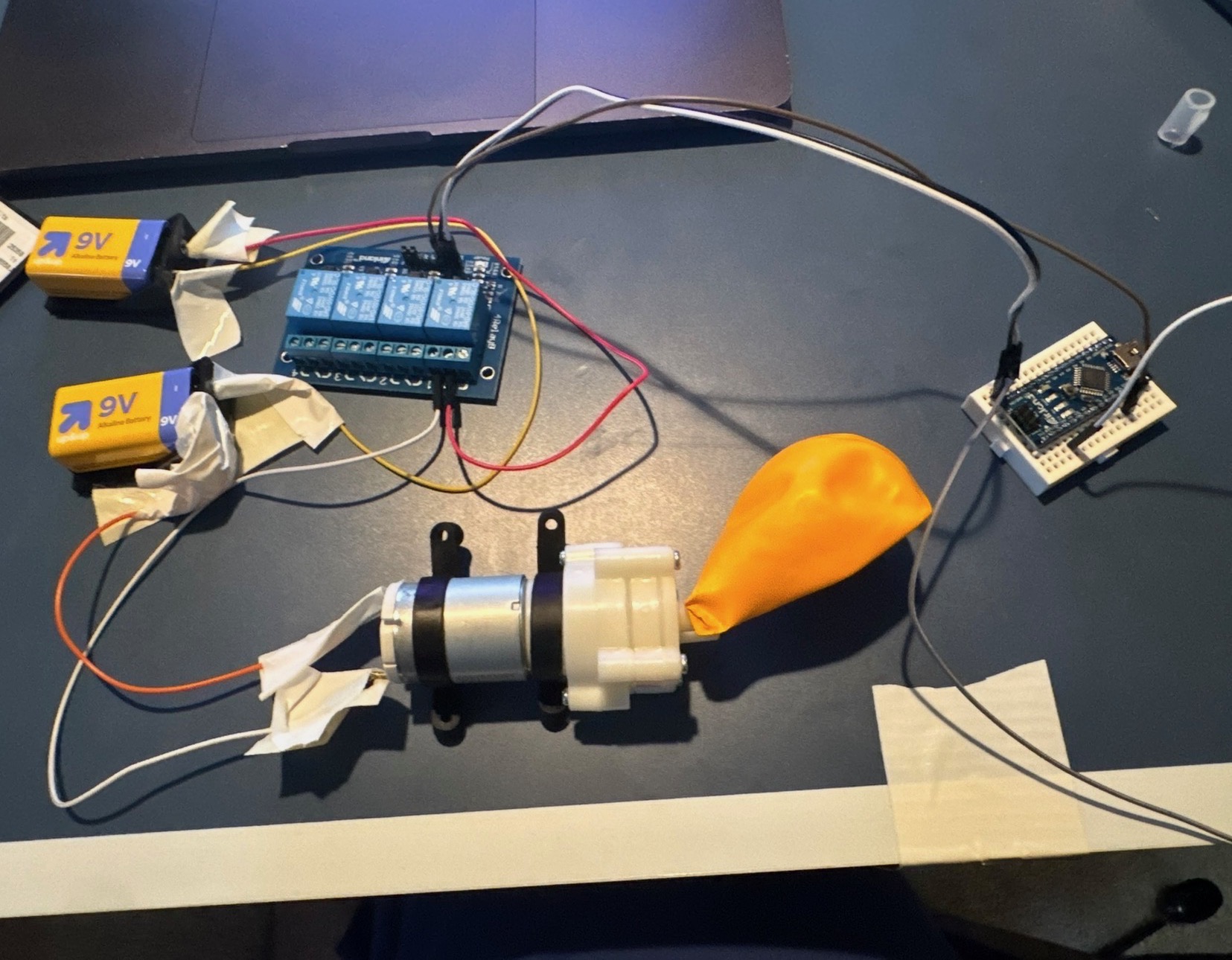
Assembly. 3D-printed capsule body, mini air pump, relay module, Arduino Nano, 9V batteries, and balloon sealing element.Bench test. Balloon inflating against a transparent PVC pipe section fed by a faucet, demonstrating the core sealing concept.
Design Review
Walking through the internals: Zoeb on the CAD
Zoeb Izzi · Fusion 360 · Full internal layout
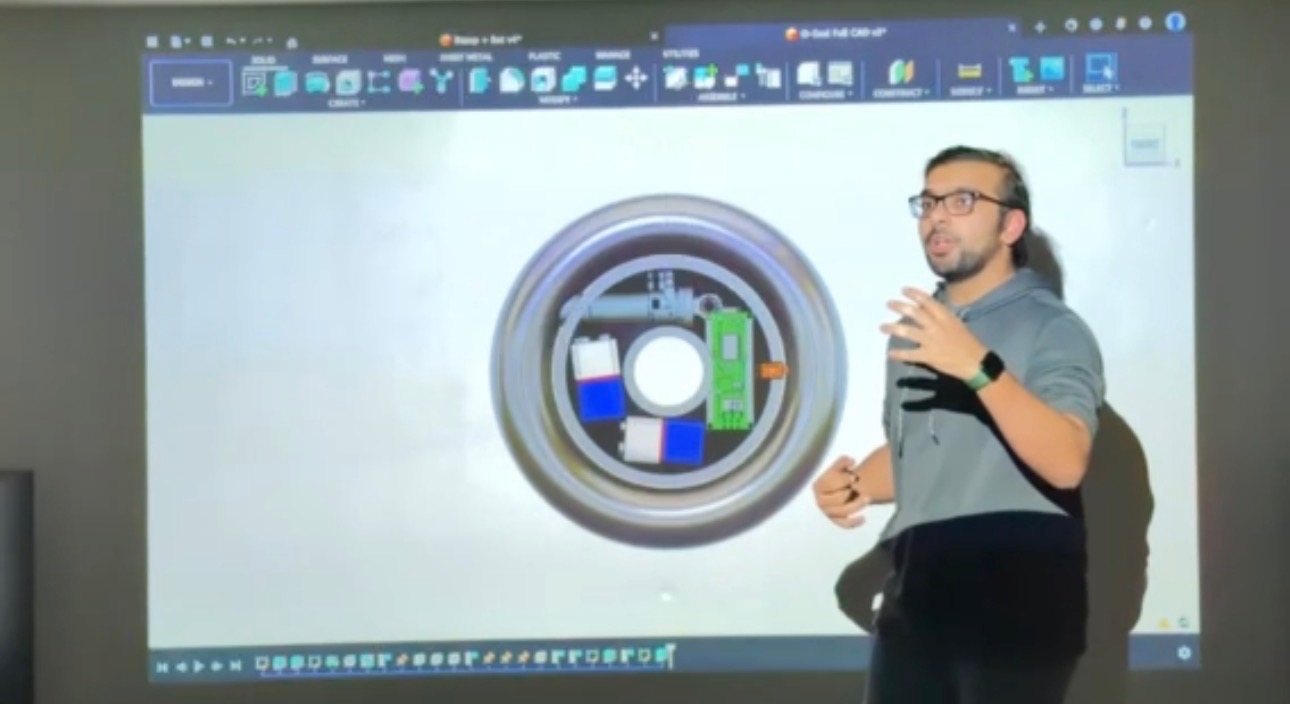
Zoeb Izzi presenting the full O-Seal CAD model in Fusion 360, projected on screen during a design review session. The top-down open-ring view behind him shows the internal component layout: battery pack, air pump, and microcontroller arranged inside the torus. He is gesturing outward to the audience as he walks through the architecture.
Top-down CAD view projected behind Zoeb shows the torus interior: battery pack (blue), air pump, and microcontroller (green PCB) laid out inside the ring.
Behind the Scenes
Building between the breaks
Tanish Reddy Gottimukkula · Hatim Ghadiali
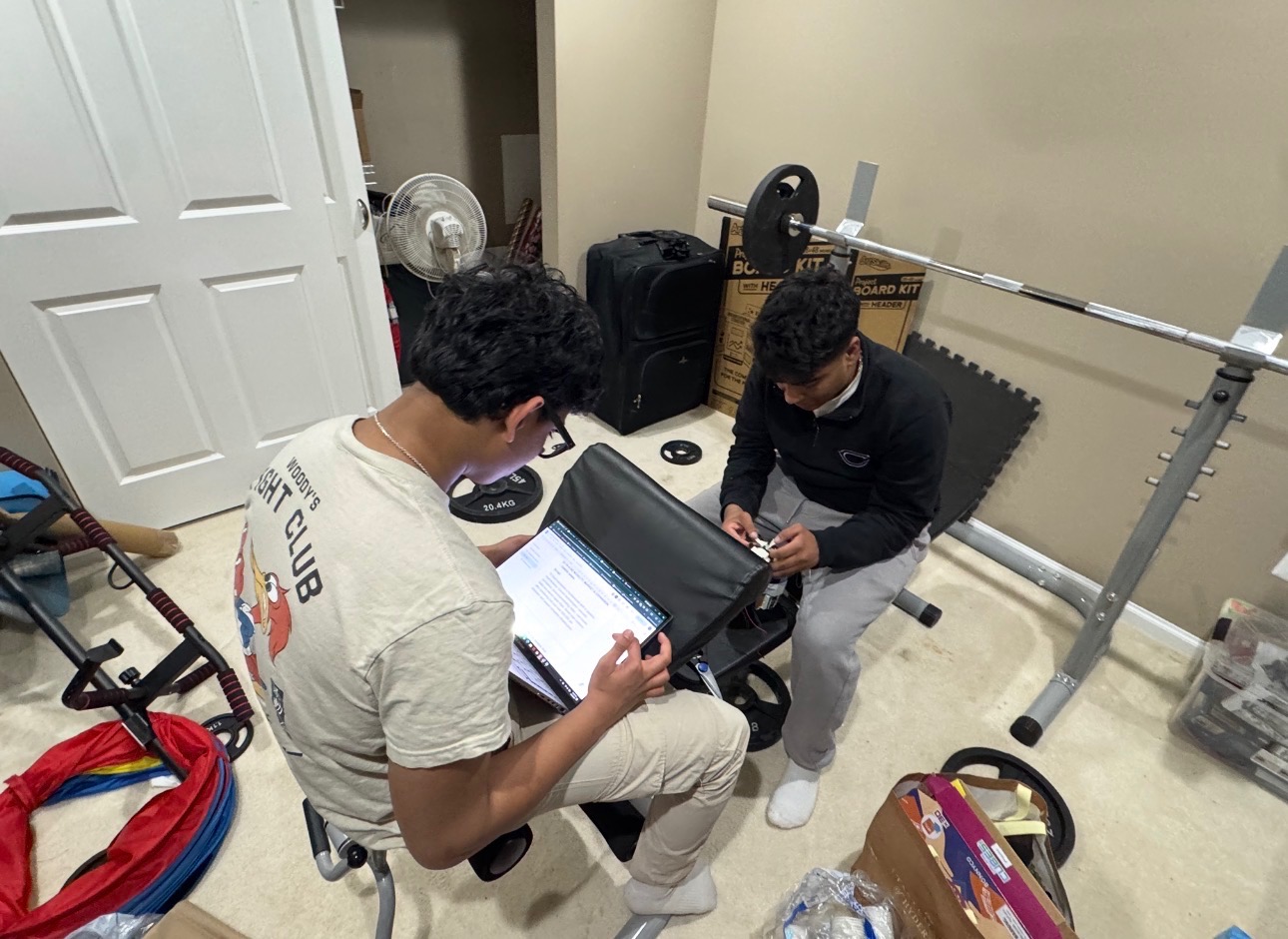
A candid from a working session right after lifting. Tanish is refining a competition submission script; Hatim is wiring a refined prototype iteration. The barbell rack in the background is not incidental — this is what the build process actually looks like.
Tanish (left) on script refinements. Hatim (right) wiring a prototype iteration. Post-lift, pre-deadline.
Invited TalkJune 27, 2026
O-Seal: Physics-Informed Neural Networks for Real-Time In-Pipe Leak Detection and Autonomous Sealing
CRUNCH Research Group · Brown University · 170 Hope Street, Providence
Hosted by Prof. George Em Karniadakis — Charles Pitts Robinson and John Palmer Barstow Professor of Applied Mathematics, Brown University — and the Computation Research in Computational and Neural Systems (CRUNCH) group, originators of Physics-Informed Neural Networks.
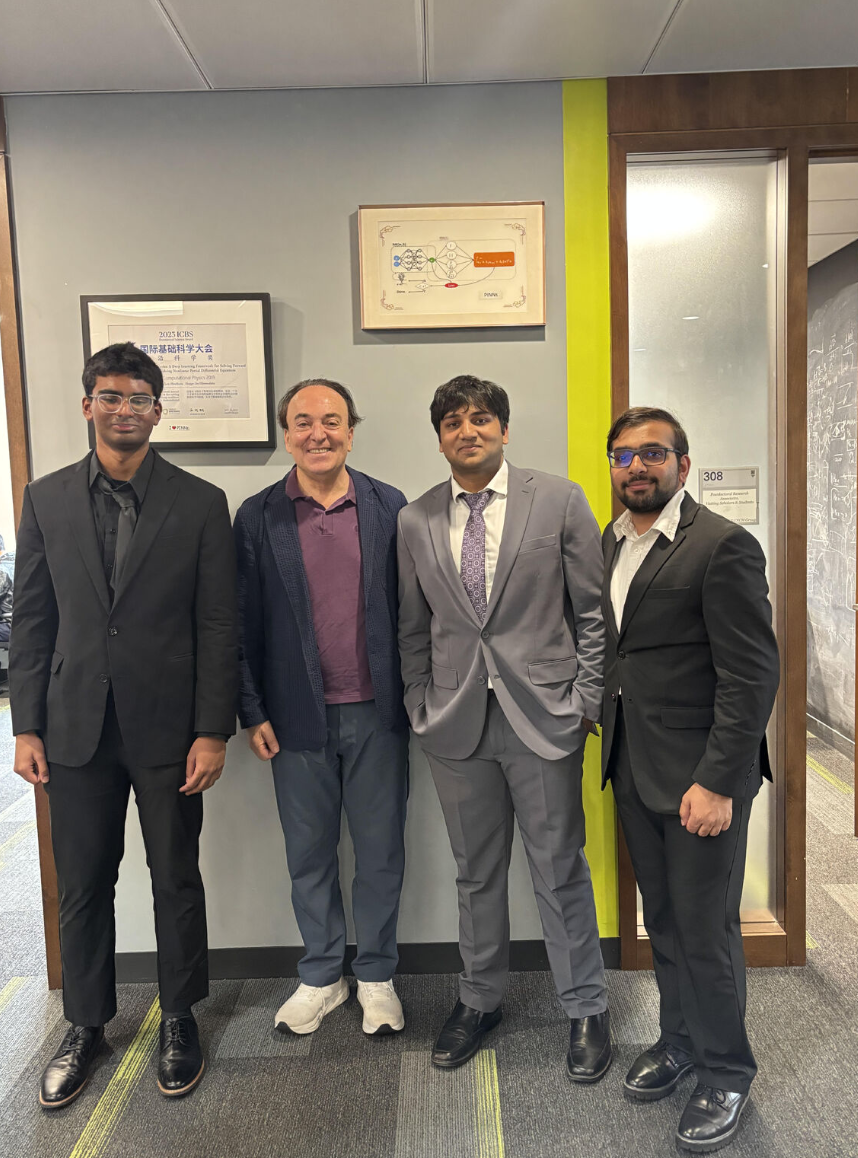
Maneesh Vaddi, Zoeb Izzi, and Dhruv Miriyala gave an invited talk to the CRUNCH group on O-Seal’s PINN-based leak detection architecture. The talk covered physics-constrained inference for leak localization, the Navier–Stokes and Hagen–Poiseuille formulations embedded in the loss function, the in-pipe sealing capsule, and multi-unit acoustic swarm coordination. Prof. Karniadakis shared the visit publicly on LinkedIn, noting the team knew “fractional derivatives.”